IWD acquires Visual Retailing and becomes the n°1 leading expert in Merchandising Software
Gabriel Becker and Nicolas Martin are excited to announce that IWD has just acquired 100% of Visual...

Planogram Software for Brands vs. Retailers: What’s the Difference?
Same shelf, different strategy. Brands and retailers may be looking at the same space, but what they need from that space—and from planogram software—can be very different.
Brands want one of two things from a retailer: space—or more of it.
For an emerging brand, simply getting a foot in the door can be the victory. Once established, the conversation often shifts to another facing, a larger footprint, better positioning or placement in additional stores.
But from the retailer's side of the table, there is no such thing as just a little more space.
A store is a grand puzzle.
At the macro level, there is only so much footage to allocate. At the micro level, every shelf and facing is part of a larger plan. Add adjacencies, traffic patterns off the drive aisle, brand recognition, merchant and vendor agreements, signage, store operations and shopability, and moving one piece inevitably affects another.
That's why planogramming is often a dance between brand ambition and retailer reality.
And why brands and retailers can look at the same shelf and ask quite different questions.
Same Shelf. Different Questions.
A retailer is asking:
What productivity will this brand bring?
Does it fit within the category? How does it complement the existing assortment? Will customers understand where to find it? Could it become a destination that drives traffic? And if I give this brand more space, what happens to everything around it?
The brand has its own questions:
Am I getting enough space to succeed?
Is my location right? Do I have enough visibility? Is my brand story coming through? Am I receiving enough support to perform—and, if I do perform, will I earn more space?
Neither side is wrong.
The retailer is responsible for the performance of the entire category. The brand is responsible for making its presence within that category successful.
A great planogram must reconcile the two.
A Brand Planogram Is the Beginning of a Conversation
Over the years, I've seen brands come to retailers with very different levels of space-planning sophistication.
Some brands created their own planograms and came to us with a clear vision for how their assortment should flow and how they wanted their products to be represented at shelf.
But a brand's preferred presentation doesn't exist in isolation. It still must work within the retailer's fixture constraints, assortment, category strategy, customer journey—and the operational realities of the store.
What looks beautiful in a presentation or digital planogram still must work when an associate sets it and a customer shops it.
That meant a brand recommendation often needed to be adapted—and sometimes substantially rebuilt—to work within the retailer's environment.
Other brands came to the table with less-developed space-planning capabilities, which gave the retailer much more freedom to determine how their products should live on the shelf.
There's an important lesson in both scenarios:
A brand's planogram is a recommendation, not the finished answer.
Planogram software can give brands a much stronger way to communicate that recommendation. Instead of simply asking for more space, a brand can demonstrate how an assortment might flow, how it fits a fixture, how products work together visually and how the customer might experience the brand at shelf.
But the strongest recommendation still needs to work within the retailer's larger puzzle.
Space Needs Data—but Data Isn't the Whole Story
When a brand wants more space, there needs to be a reason.
Ben Durham, President and Co-Founder of Gimme Beauty, understands the challenge from the brand's side of the table.
"The buyers are up against so much and I often hear them express how hard it is to decide between so many great products. This makes it our job to communicate with data and vision how this product or merchandising experience will generate growth and loyal shoppers."
It's an important distinction. A brand isn't simply competing for shelf space. It's making a case for how that space will contribute to the retailer's success.
Sales-to-space analysis can help determine whether a brand, category or product is under-spaced, over-spaced or already right-sized. Productivity analysis can identify top and bottom performers, unnecessary duplicate facings and opportunities to make better use of finite space.
For an established brand, performance data can make a powerful case for expansion.
For a newer brand, the story may be less complete.
Perhaps there isn't enough history with that particular retailer yet. Maybe performance at another retailer demonstrates how the product ramps up over time. Perhaps awareness and word of mouth need time to build.
I've seen new brands take off right out of the gate. I've also seen highly anticipated launches struggle to gain traction. Most fall somewhere in between—and sometimes, a promising brand simply needs time to find its customer and build momentum.
That's why measurement after launch matters just as much as the initial planogram.
Did the brand perform as expected? Did additional space produce additional productivity? Is momentum building—or isn't it?
And sometimes the answer isn't simply yes or no.
Sometimes the smartest answer is: test it.
A compelling brand story may justify taking a calculated chance in the right stores or markets, measuring the response and letting actual customer behavior help determine what happens next.
Sometimes the Hardest Question Isn't “How Much?” It's “Where?”
There were times when we genuinely loved a new brand.
The product was interesting. The packaging looked great. The story was compelling.
And then came the deceptively difficult question:
Where does it belong?
A new brand doesn't enter an empty store. It must find its place within an existing assortment, customer journey and physical environment.
That question is especially interesting in beauty, fashion and lifestyle categories, where products increasingly blur traditional boundaries and shoppers may discover brands in ways that don't fit neatly into yesterday's category structure.
A brand that understands not only how it wants to look, but also where and why it belongs, comes to the retailer with a much stronger story.
There's a Third Person at the Shelf
For all the discussion about what the brand wants and what the retailer needs, it's remarkably easy to forget someone: the customer.
Ultimately, a successful planogram should be intuitive to navigate, easy on the eyes, easy to shop and, when appropriate, educational.
Gimme Beauty offers a great example of how a brand can use its shelf presence to make shopping easier.
Recognizing that women often shop for hair accessories based on their hair type, the company refreshed its packaging to create a more intuitive shopping experience. Pink represents fine hair, blue represents medium hair and purple represents thick hair.
The result is a distinctive visual brand block that helps customers quickly identify the products designed for them.
As Ben Durham, President and Co-Founder of Gimme Beauty, puts it:
“We are just grateful to get space and consider that space our stewardship.”
It's a simple but effective example of how thoughtful packaging and merchandising can work together to tell a story at shelf.
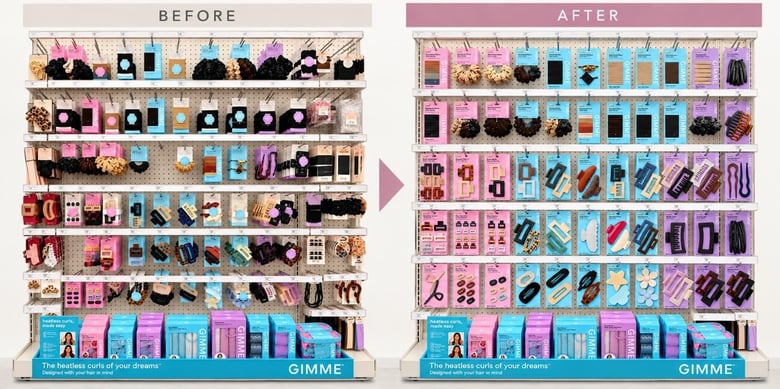
Illustrative rendering based on Gimme Beauty’s merchandising materials, showing the transition to color-coded packaging at Target. Product imagery courtesy of Gimme Beauty; display visualization digitally adapted.
Storytelling matters. Packaging matters. Brand blocking and adjacencies matter. Signage matters. Sometimes a unique display rather than a traditional shelf presentation can completely change how a product is discovered.
But none of those things exist in isolation.
The best space planning brings the art and the science together: the visual experience that attracts the customer and the analytics that help make the space productive.
Because a planogram can make perfect sense on a spreadsheet and still fail the person standing in front of it.
The Best Brand Partners Don't Just Present. They Listen.
The strongest brand partners I've worked with didn't simply arrive with their own sales analytics and use them to argue for more space.
They listened.
They wanted to understand the retailer's customer, what the overall category performance was saying and what the retailer was trying to accomplish.
Then we collaborated.
For Durham, that responsibility extends beyond winning space to earning the retailer’s confidence in how the brand is presented:
“The more we own helping them win with the elements we can impact, the more they will trust us in how it should be merchandised.”
At the same time, retailers need to listen too.
Brands often have extensive consumer research, market knowledge and a story behind their products that historical retailer sales data can't yet capture. A new idea shouldn't necessarily be dismissed simply because it hasn't had enough time to create a track record.
The brand's biggest mistake may be asking for space without the data or story to support the ask.
The retailer's biggest mistake may be refusing to take a calculated chance on a compelling brand simply because the data isn't there yet.
Somewhere between those two positions is usually a much better conversation.
And Please—Get the Dimensions Right
For all the talk about analytics, brand experience and sophisticated software, one of the most important inputs in a planogram is decidedly less glamorous:
Height. Width. Depth.
Get those wrong and everything downstream can be wrong.
A beautiful digital planogram doesn't accomplish much when the store discovers the products don't actually fit.
Accurate dimensions—and accurate product images—are foundational to creating something that can make the leap from screen to shelf.
It's not sexy.
But ask a space planner how much bad dimensions matter and you may want to pull up a chair.
That's another article entirely.
Different Objectives. Same Shelf.
So, do brands and retailers really need different planogram software?
Maybe the better question is whether they need planogram software to solve different business problems.
The retailer is allocating finite space across categories, brands and products while trying to create an assortment that serves the customer and produces results.
The brand is trying to visualize its strategy, communicate its story, make a credible case for its space and show how its assortment can succeed within the retailer's environment.
The best technology doesn't need to eliminate that tension. It needs to give both sides better information to navigate it.
Because ultimately, the most productive shelf isn't created by a brand or a retailer alone.
It's built in collaboration.
Never miss out on latest news in the retail industry on Facebook, Youtube, LinkedIn or Instagram.